
Valorant has 9 ranks and 25 tiers: Iron, Bronze, Silver, Gold, Platinum, Diamond, Ascendant, Immortal, and Radiant. Iron through Immortal each have three divisions, while Radiant is a single rank for the highest ranked players in each region. Your visible progress from Iron through Ascendant is measured with Rank Rating (RR). You gain RR for wins and lose RR for defeats, with 100 RR required for promotion. Your hidden Matchmaking Rating (MMR) also affects how quickly your RR moves toward your current skill level.
If the ranked climb feels too slow, a Valorant boost can help you reach your target rank without completing every match yourself.
From this guide, you will learn:
- Ranks in Order
- How Do Valorant Ranks Work
- What Ranks Can Play Together
- Rank Distribution
- When Do Valorant Ranks Reset
- MFA and Ranked Access
- Premier Ranks
- CS2 Ranks to Valorant
All Valorant Ranks in Order
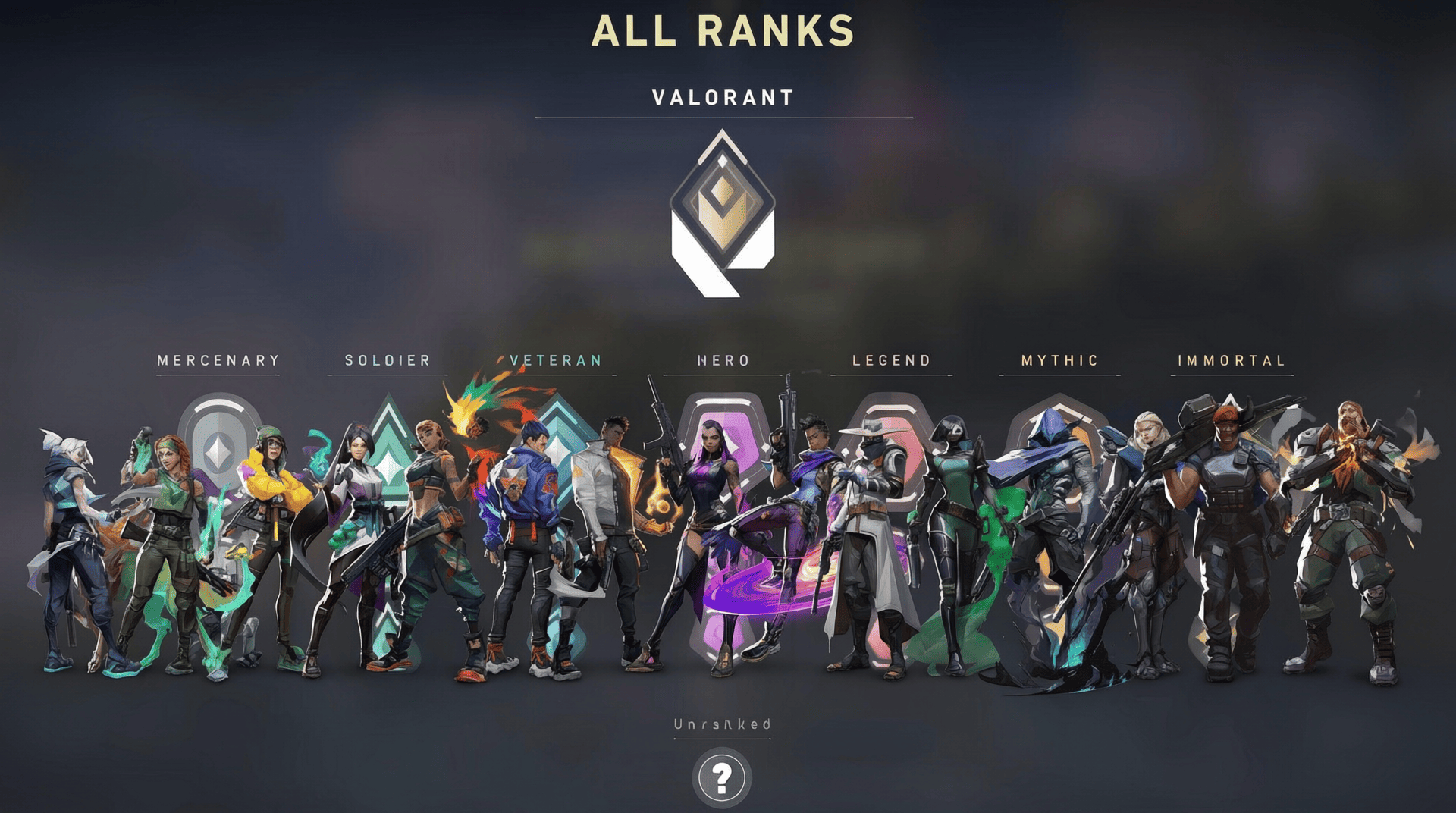
Valorant has nine competitive ranks, with three divisions in every rank except Radiant. That creates 25 visible tiers from Iron 1 to Radiant. Ascendant was added in patch 5.0 between Diamond and Immortal.
| Rank | Divisions |
| Iron | Iron 1 / Iron 2 / Iron 3 |
| Bronze | Bronze 1 / Bronze 2 / Bronze 3 |
| Silver | Silver 1 / Silver 2 / Silver 3 |
| Gold | Gold 1 / Gold 2 / Gold 3 |
| Platinum | Platinum 1 / Platinum 2 / Platinum 3 |
| Diamond | Diamond 1 / Diamond 2 / Diamond 3 |
| Ascendant | Ascendant 1 / Ascendant 2 / Ascendant 3 |
| Immortal | Immortal 1 / Immortal 2 / Immortal 3 |
| Radiant | Single rank with no divisions |
 Competitive unlocks at Account Level 20. Players who have not previously played Competitive must reach Account Level 20 before entering the mode. New players then complete placement matches to receive their initial rank.
 The highest placement rank is Ascendant 3. Riot raised the placement ceiling from Ascendant 1 to Ascendant 3 in patch 11.00. This means a player cannot receive Immortal directly from placements.
 PC and console use separate competitive environments. Valorant has cross progression and cross inventory, but PC and console do not use cross play. Competitive progress and statistics are tracked separately by platform.
How Do Valorant Ranks Work
RR is the visible progression system from Iron through Ascendant. You normally need 100 RR to promote to the next division. After promotion, you start the new division with at least 10 RR, which gives you some protection against an immediate demotion.
Four factors affect RR changes:
- Match result. Winning or losing is the main factor in your RR change.
- Round differential. The number of rounds won and lost affects the size of the RR change.
- Individual performance. Performance can influence RR from Iron through Ascendant.
- MMR convergence. Your hidden MMR affects how quickly your visible rank moves toward your estimated skill level.
MMR and RR are not the same thing. MMR is a hidden skill rating used by Valorant matchmaking, while RR is the visible score attached to your current division. When your MMR is higher than your displayed rank, you can gain more RR for wins and lose less for defeats. When your rank is higher than your MMR, the opposite pattern can occur. Riot also updated the hidden MMR calculation in patch 12.00 to improve match quality.
Double promotions can happen when your rank is far below your MMR. The system uses convergence to move your visible rank toward the skill level represented by your MMR. Once your rank and MMR become closer, RR gains and losses normally become more balanced.
Rank Shields protect Tier 1 ranks. Patch 10.01 added two Rank Shields to Tier 1 divisions such as Gold 1, Platinum 1, and Ascendant 1. A loss at 0 RR consumes one shield. After three losses at 0 RR, you demote to the previous rank. Rank Shields return when you enter Tier 1 again through promotion or demotion.
 Immortal and Radiant use a leaderboard based system. Immortal players continue earning RR beyond the normal 100 RR division structure. Radiant requires both the regional RR threshold and a sufficiently high leaderboard position. Riot adjusted the Immortal 2, Immortal 3, and Radiant RR thresholds in patch 12.05 to bring the regional requirements closer together.
Radiant is limited by both RR and leaderboard position. The exact RR threshold varies by region, and reaching the threshold alone does not guarantee Radiant. You must also be high enough on your regional leaderboard.
Competitive penalties can affect RR. Queue dodging, AFK behavior, and other forms of leaving Competitive matches can result in additional penalties. The exact penalty depends on the situation, so fixed RR values should not be treated as universal rules.
What Ranks Can Play Together in Valorant
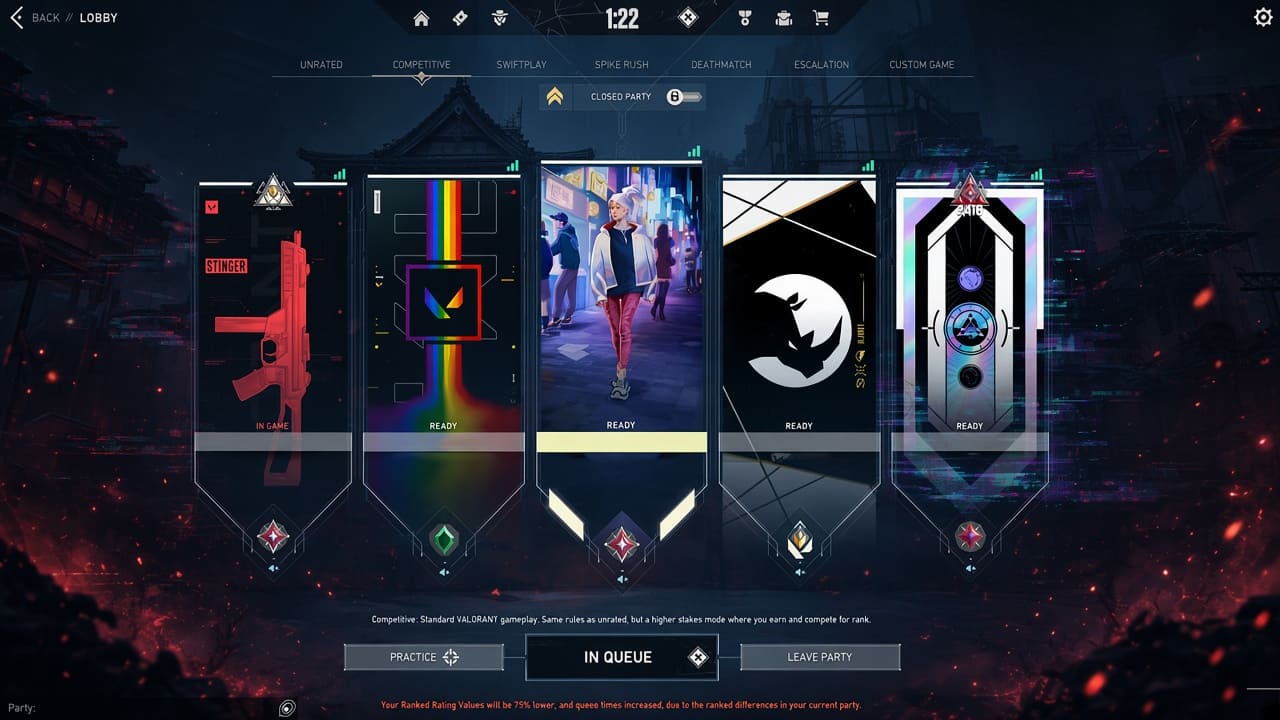
Duos and trios have rank restrictions, while five stacks can include any ranks. The allowed range becomes narrower as rank increases. Four player parties cannot enter Competitive.
| Lowest rank in party | Highest allowed rank |
| Iron or Bronze | Silver 3 |
| Silver | Gold 3 |
| Gold | Platinum 3 |
| Platinum | Diamond 3 |
| Diamond | Ascendant 3 |
| Ascendant | Immortal 3 |
| Immortal | Radiant |
| Radiant | Radiant |
Lower ranks have wider party ranges. An Iron or Bronze player can queue with a player up to Silver 3. A Silver player can queue with Gold players, while the allowed range becomes one full rank from Platinum upward.
Platinum and higher use a one rank range. For example, Diamond 2 can queue with ranks within the allowed one rank range, while Ascendant 3 cannot queue with Diamond 2 in a duo or trio.
 Immortal and Radiant parties are limited to solo, duo, or five stack. Trios are not available for players at Immortal 1 and above.
 Five stacks can ignore the normal rank restrictions, but RR penalties apply.
- 25% reduction can apply when a five stack is outside the normal party range while all players are Ascendant 3 or below.
- 25% reduction applies when a five stack includes an Immortal 1 through Immortal 3 player.
- 75% reduction applies when a five stack includes a Radiant player.
- 90% reduction applies when a Radiant player queues with anyone below Radiant.
Valorant Rank Distribution by Percentage of Players
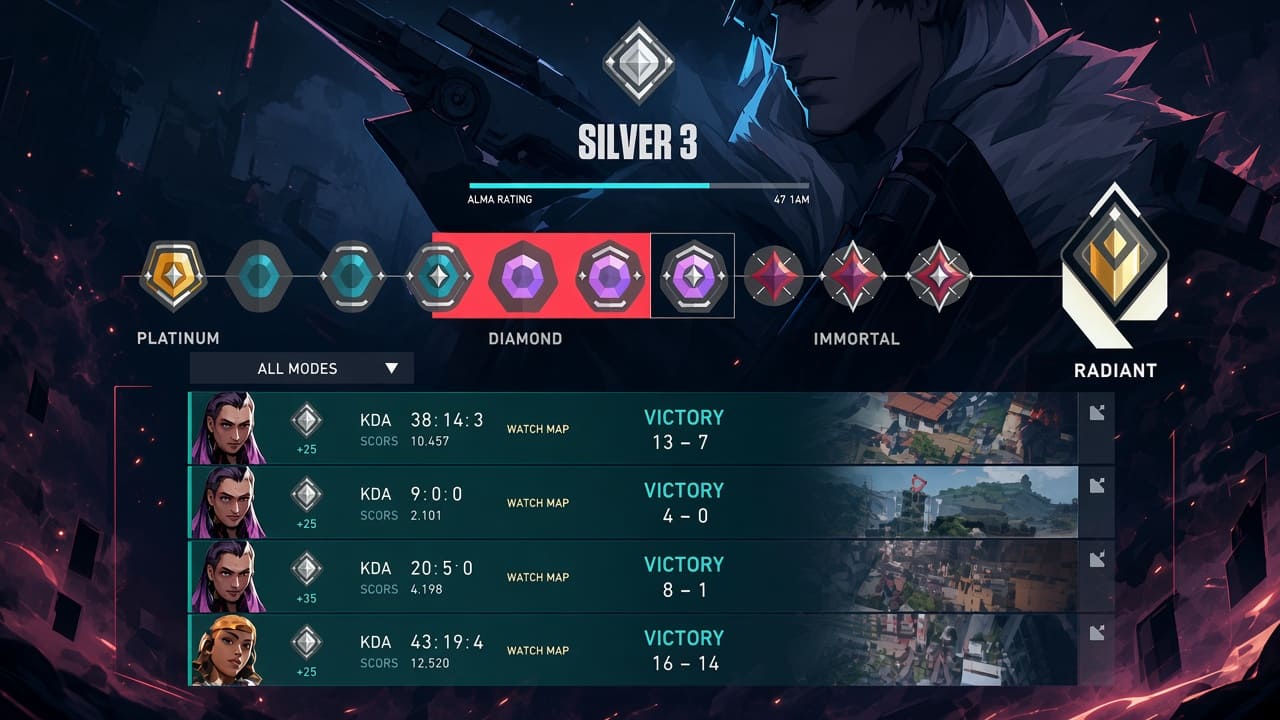
 Gold is the largest rank group in the September 2026 snapshot. Gold represents 22.12% of ranked players, followed by Silver at 20.66% and Platinum at 17.56%. The distribution changes during the season as players move through the ladder.
 Data from September 2026 based on Season 2026 V26 Act 5:
| Rank | % of players | Top % |
| Iron | 4.67% | 95.33% |
| Bronze | 15.72% | 79.61% |
| Silver | 20.66% | 58.95% |
| Gold | 22.12% | 36.83% |
| Platinum | 17.56% | 19.27% |
| Diamond | 11.55% | 7.72% |
| Ascendant | 6.32% | 1.40% |
| Immortal | 1.37% | 0.22% |
| Radiant | 0.05% | 0.05% |
 The distribution changes throughout each act. In September 2026, Platinum or higher represented about the top 19% of the ranked population, Diamond or higher about the top 7.7%, and Ascendant or higher about the top 1.4%.
Radiant remains a special case. The percentage shown in distribution data is only a snapshot of the active ranked population. Radiant is controlled by the regional leaderboard and is limited to the top 500 players per region rather than a fixed percentage of the global player base.
When Do Valorant Ranks Reset
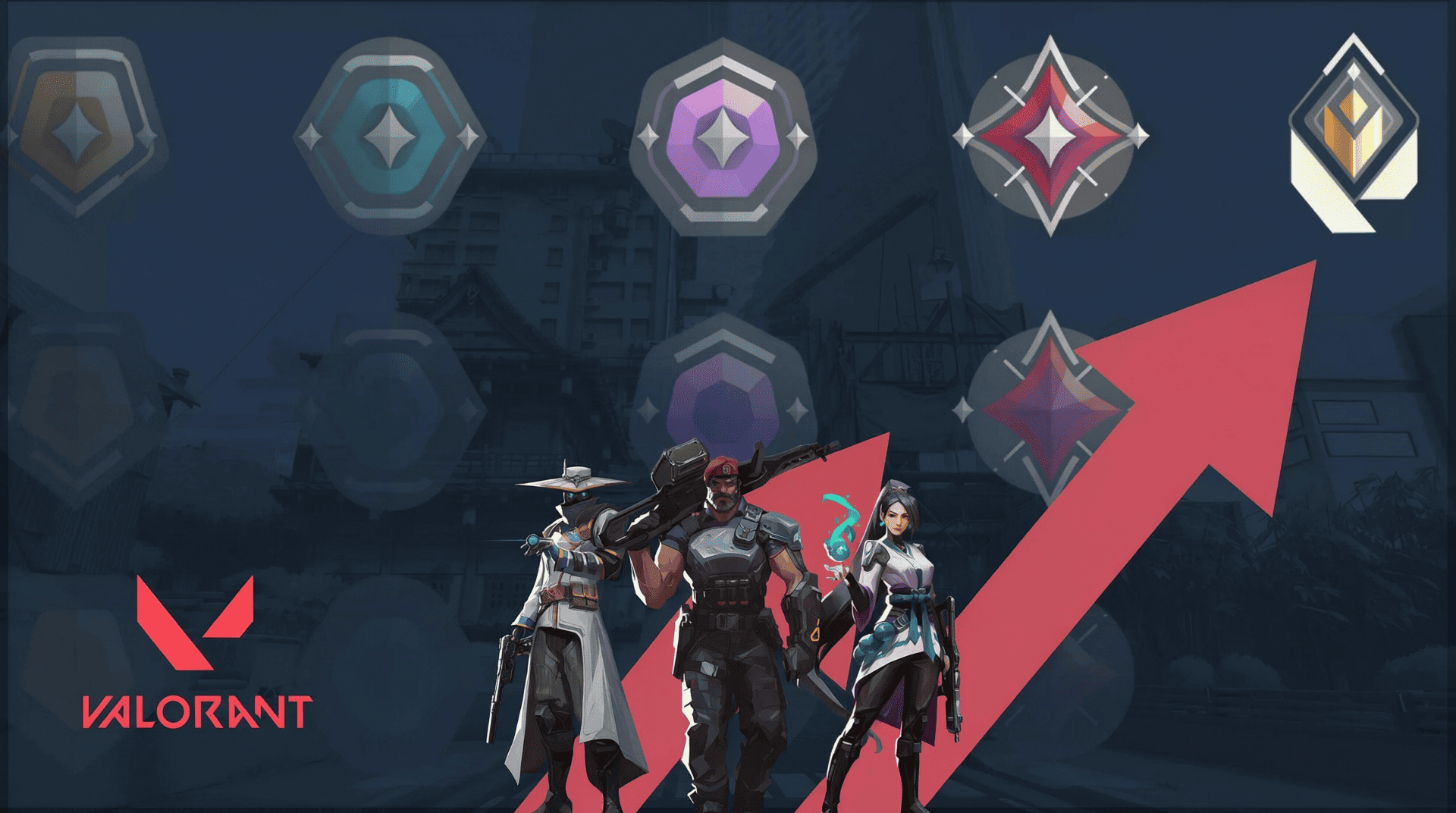
Valorant uses six Acts during the 2026 season. Competitive resets are tied to the start of the season and the midseason reset. Other Act transitions use a lighter placement process rather than wiping the entire ranked system.
| Reset | Placement games | Rank effect | 2026 timing |
| Season start | 5 | Full competitive placement | Act 1 |
| Midseason | 5 | Rank reset with placement | Act 4 |
| Other Act transitions | 1 | Light recalibration | Acts 2, 3, 5, and 6 |
A placement reset does not erase your hidden MMR. Riot uses your previous competitive history and MMR when determining where you should start. This is why your placement rank can differ from the rank you held before the reset.
Patch 11.00 raised the maximum placement rank to Ascendant 3. Riot also adjusted the midseason reset so players could see a smaller rank drop after placements than under earlier reset systems.
Immortal and Radiant reset through the leaderboard system. At the start of a new Act, high rank players must complete the required placement game to appear on the leaderboard again. Immortal and Radiant players also have their RR reduced as part of the reset process.
Valorant does not normally decay your rank because of inactivity. Returning players may still see different matchmaking results after a break because MMR and current ranked conditions can change over time.
MFA and Ranked Access

Riot Mobile MFA is required for certain Competitive accounts. Riot introduced MFA requirements for accounts detected as shared accounts and later expanded the requirement to all Ascendant and higher players in several regions.
The requirement now covers major regions in stages. In NA, LATAM, BR, and KR, Riot introduced the Ascendant and higher requirement in patch 11.10. EU received the requirement in patch 12.01, while APAC received it in patch 12.03. Accounts detected for sharing can also be required to enable MFA.
MFA is required to access Competitive when the account falls under the applicable regional rules. Other Valorant modes are not affected by this Competitive access requirement.
Valorant Premier Ranks
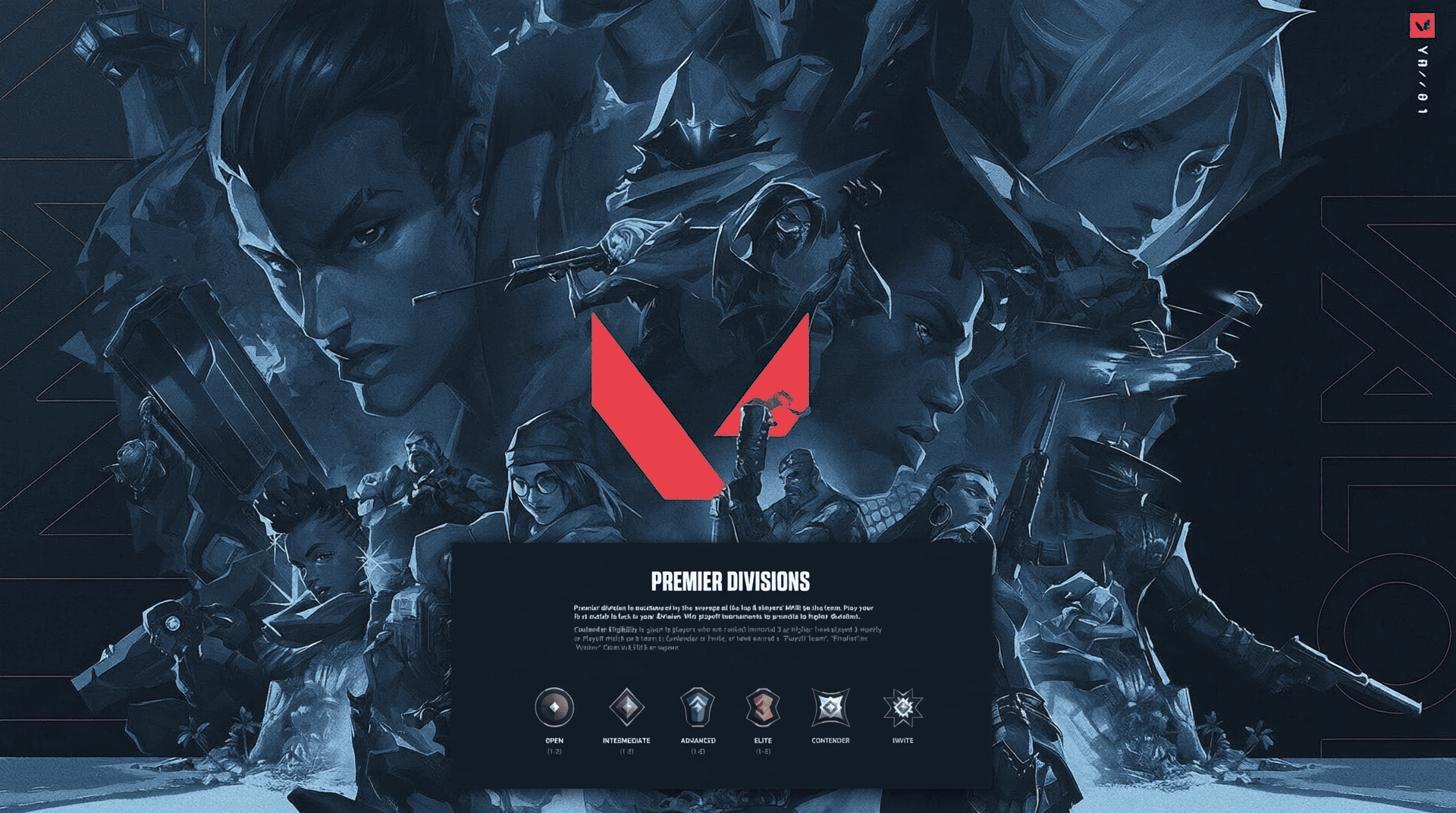
Premier is a separate team competition system. Your Premier Division is not the same thing as your Competitive rank. Premier teams are placed according to team MMR and compete through scheduled stages and playoffs.
Premier has six divisions.
- Open
- Intermediate
- Advanced
- Elite
- Contender
- Invite
Open through Elite use five tiers. These divisions run from tier 1 through tier 5. Contender and Invite operate differently and are the highest Premier divisions.
Team placement is based on the MMR of the team’s top five players. A player’s normal Competitive rank does not directly determine the team’s Premier Division. Invite is the highest Premier division and is part of Riot’s path toward higher level competitive play.
CS2 Ranks to Valorant: Mechanics Comparison
CS2 Premier rating does not convert directly into a Valorant rank. CS2 uses an open numerical Premier rating, while Valorant uses ranked tiers backed by hidden MMR and RR. The two systems measure progression differently, so a CS2 rating should not be treated as an official equivalent of a Valorant rank.
| CS2 Premier | Valorant Competitive |
| Numerical Premier rating | Rank and division |
| Open ended rating scale | 25 tiers from Iron 1 to Radiant |
| Rating displayed as a number | RR displayed within Iron through Ascendant |
| Premier rating determines leaderboard position | MMR and RR determine ranked progression, while Immortal and Radiant also use regional leaderboards |
Treat cross game rank comparisons as estimates. A player can have very different results in CS2 and Valorant because the games use different matchmaking systems, weapon mechanics, abilities, maps, and rating structures.
FAQ
What is the highest rank in Valorant?
Radiant is the highest Valorant rank. Radiant has no divisions and is reserved for the highest ranked players on each regional leaderboard. Reaching the required RR threshold is not enough by itself because you also need a sufficiently high leaderboard position.
What is the average rank in Valorant?
Gold is the largest rank group in the September 2026 distribution snapshot. Gold represented 22.12% of ranked players, while Silver represented 20.66% and Platinum represented 17.56%. The exact distribution changes throughout each Act.
How many RR do you need to rank up?
You normally need 100 RR to promote from one division to the next. After promotion, you start the new division with at least 10 RR. The amount gained or lost per match depends on the result, round differential, individual performance where applicable, and the relationship between your rank and MMR.
Can Iron play with Gold in Valorant?
Not in a normal duo or trio. Iron players can queue with ranks up to Silver 3. A five stack can contain wider rank differences, but the group can receive reduced RR gains and losses.
What is the difference between RR and MMR?
RR is your visible ranked progression, while MMR is a hidden matchmaking rating. RR shows your current progress within a division. MMR is used by the matchmaking system to estimate your skill and can affect how quickly your RR moves toward the appropriate rank.
How many placement matches do I need to play?
The number depends on the reset. New competitive placements and the major midseason reset use five placement matches. Regular Act transitions use one placement match for players who already have a rank from the previous Act.
What is an Act Rank badge?
Your Act Rank records your competitive achievement during an Act. Riot changed the system so your Act Rank is based on the highest ranked win represented in your Act Rank progress, while the badge also records your competitive achievement for that Act.
Do Valorant ranks transfer between PC and console?
Competitive progression is separate between PC and console. Valorant supports cross progression and cross inventory, but PC and console do not use cross play. Your competitive experience is therefore tracked separately by platform.
Is MFA required for Valorant Competitive?
MFA is required for certain accounts and regions. Riot requires Riot Mobile MFA for all Ascendant and higher players in EU, as well as for accounts covered by the regional account sharing rules. Similar Ascendant and higher requirements also apply in NA, LATAM, BR, KR, and APAC under their respective rollout dates.
How many Premier divisions are there in Valorant?
Premier has six divisions. They are Open, Intermediate, Advanced, Elite, Contender, and Invite. Open through Elite use five tiers, while Contender and Invite use their own competitive structure.
